 enquiries@theregconsultants.com


 0
0
Welcome to The Reg Consultants Pte Ltd (TRC)
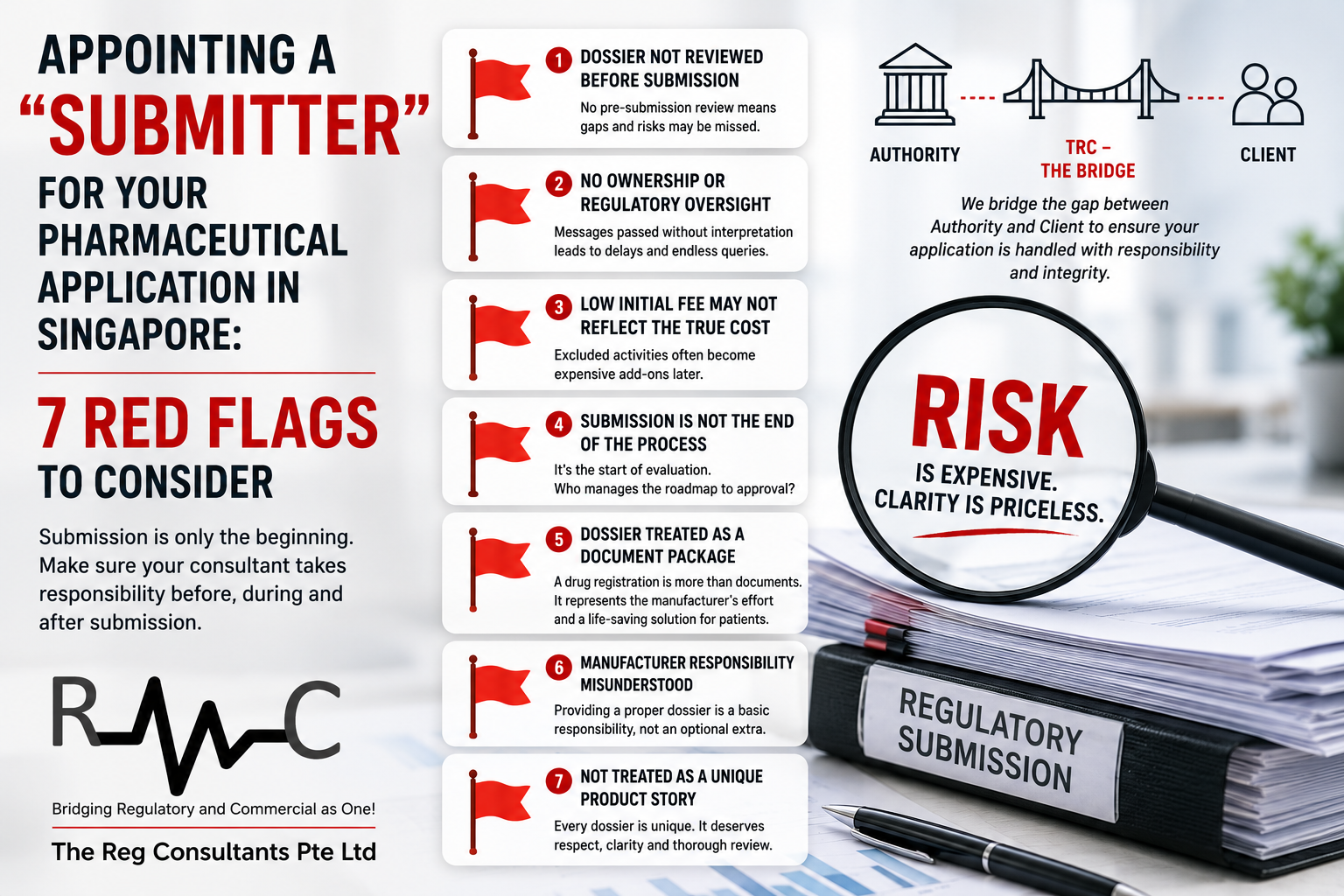
In the course of our work, we often encounter situations where regulatory consultants are treated as merely a pair of hands to execute the submission.
A regulatory consultant is not an administrative resource.
Regulatory consultants bring trained regulatory knowledge and experience in the local market. Their role should include reviewing and assessing an application from the perspective of the local regulatory requirements and considering how the application may be viewed by the relevant authority.
This assessment is important because regulatory risks are often best addressed before submission, rather than after the authority has identified them.
A regulatory consultant can also act as a bridge between the applicant and the authority, helping to ensure that the application is appropriately prepared, submitted and managed throughout the regulatory process.
However, this also comes with responsibility.
When a consultant is appointed to support a pharmaceutical application, professional responsibility and regulatory integrity should not disappear simply because the client has requested a “submission-only” service.
For applicants considering such an arrangement, here are seven red flags worth considering.
A pharmaceutical application is not simply a collection of documents that needs to be uploaded into a submission system.
Before submission, the dossier needs to be reviewed to ensure that the applicable requirements have been addressed and that the regulatory documents are presented in an appropriate structure.
A submission-only arrangement may leave a gap between preparation of the dossier and regulatory assessment of the dossier.
Applicants should therefore clarify:
The objective should not simply be to achieve a successful electronic submission. The objective should be to submit an application that is appropriately prepared for regulatory evaluation.
A consultant who simply passes messages between the applicant and the authority can become little more than a messenger.
Questions are received.
Messages are forwarded.
Responses are collected.
Documents are sent back.
But who actually interprets what the regulator is asking?
Without regulatory ownership and oversight, communication can become a series of exchanges without a clear regulatory strategy behind them. This can result in unnecessary back-and-forth, additional clarification and potentially longer timelines.
The consultant’s value should not simply be in moving information from one party to another. It should be in understanding what the information means from a regulatory perspective and helping the applicant respond appropriately.
Submission-only services can appear attractive because the initial fee may be lower than an integrated regulatory service.
However, applicants should look carefully at what is actually included.
If dossier assessment, regulatory strategy, deficiency review, responses to authority queries, coordination with the manufacturer and other regulatory activities are excluded, these activities may subsequently become separate chargeable services.
This can create misunderstandings between the client and consultant.
The question should therefore not simply be:
“How much does the submission cost?”
It should also be:
“What regulatory work is included before and after submission, and what happens when the authority raises questions?”
A transparent scope is important for both the applicant and the consultant.
One of the biggest misconceptions about pharmaceutical registration is that submission represents the completion of the regulatory work.
It does not.
Submission marks the beginning of the authority’s evaluation of the application.
Once an application enters evaluation, questions may arise regarding the quality, safety, efficacy, pharmaceutical development, manufacturing information or other aspects of the dossier.
At this stage, the applicant needs someone who can understand the regulatory question, interpret what the authority is seeking and coordinate an appropriate response.
Without someone taking responsibility for the regulatory roadmap, the process can become a cycle of forwarding questions and collecting answers.
Regulatory correspondence should not become a simple cut-and-paste exercise.
Registration of a pharmaceutical product can sometimes appear straightforward when viewed as a checklist of documents.
The reality is very different.
Behind every dossier is the work undertaken by the manufacturer and development team to develop a product for patients.
The regulatory submission brings together pharmaceutical development, manufacturing knowledge, quality data, non-clinical information and clinical evidence into one coherent application.
The consultant’s role is not to replace the manufacturer’s responsibility for the dossier. Rather, the consultant should help ensure that the information is appropriately presented and that the regulatory story is clear.
The objective is to present the manufacturer’s work as a complete and coherent regulatory package, rather than simply submitting individual pieces of information.
Regulatory responsibility should not be confused with dossier ownership.
The manufacturer and applicant remain responsible for providing the underlying information and ensuring that the dossier is appropriately prepared.
As we discussed in our previous article on the risks of recycling an old dossier for a new registration, an existing dossier should not simply be treated as a document package that can be reused without proper assessment.
The same principle applies when appointing a regulatory consultant.
Providing a properly prepared dossier is a fundamental part of the registration process. It should not be treated as an optional value-added activity that can simply be removed from the regulatory scope in order to reduce the submission fee.
A good regulatory process requires cooperation between the manufacturer, applicant and regulatory consultant.
Whether the product is a generic drug, a new drug, a biologic or a biosimilar, every dossier represents the work and investment of the company developing the product.
The regulatory presentation should therefore be treated with appropriate care and respect.
A dossier should be thoroughly reviewed, cleaned up and assessed before submission. Its information should be coherent, its regulatory rationale should be understood and its key messages should be appropriately presented.
The role of the regulatory consultant should be to help identify where the regulatory story may not yet be sufficiently clear — before the application reaches the authority.
That is where regulatory expertise creates value.
At TRC, we do not operate as a submission-only service for pharmaceutical registration.
We believe that regulatory registration is an integrated process in which pre-submission assessment, submission and regulatory evaluation are connected.
Our responsibility is not simply to submit whatever information is provided to us.
Where we identify a regulatory concern or an issue that may affect the application, we will inform the client accordingly. If we believe that something needs to be addressed before submission, we would rather identify it early than allow the issue to become a deficiency during evaluation.
This approach is intended to help clients avoid unnecessary expenditure, delays and avoidable rounds of regulatory questions.
Ultimately, appointing a regulatory consultant should not be about finding someone who can simply press “submit.”
It should be about appointing someone who understands what is being submitted, why it is being submitted, how it may be evaluated, and what happens after the submission is made.
That distinction is worth considering before choosing a submission-only arrangement.

If you have any specific regulatory questions pertaining to entering the Singapore market or require assistance with pharma regulatory services and medical product registration, feel free to reach out. Your success in the pharmaceutical industry starts with us!