 enquiries@theregconsultants.com


 0
0
Welcome to The Reg Consultants Pte Ltd (TRC)
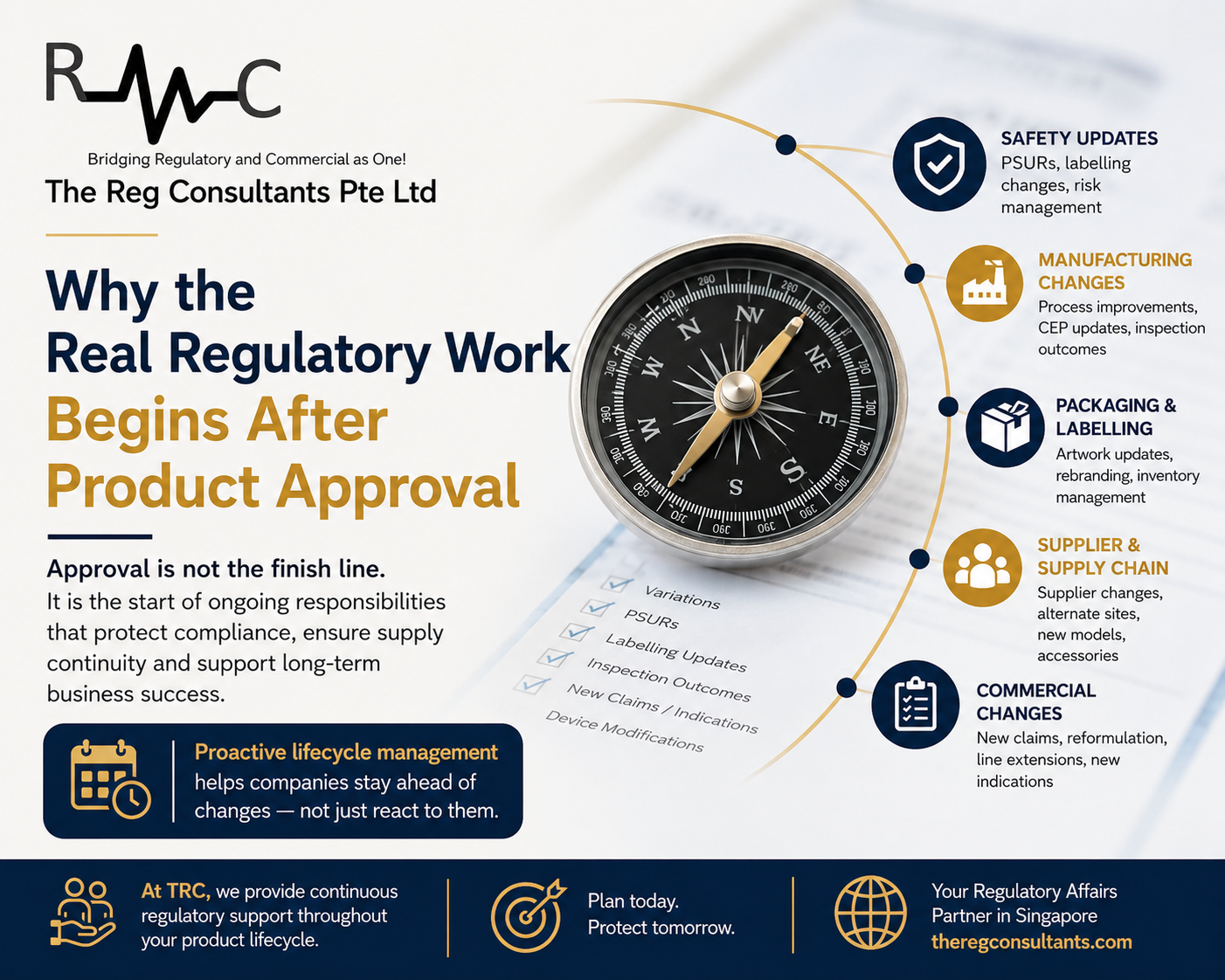
Many companies celebrate once their product receives regulatory approval. Marketing campaigns begin, commercial supply is launched, and attention quickly shifts towards sales and business expansion.
However, experienced regulatory professionals know that product approval is not the finish line. In reality, it marks the beginning of a continuous regulatory lifecycle.
Throughout the years following approval, products continue to evolve. Manufacturing processes improve, safety information is updated, suppliers change, formulations are refined, labels are revised, and regulatory expectations continue to develop. Companies that fail to plan for these post-approval obligations often discover that maintaining compliance requires considerably more effort and resources than obtaining the original approval itself.
For pharmaceutical products, pharmacovigilance activities continue long after approval. Safety teams constantly monitor, evaluate and characterise emerging safety signals to ensure that products continue to demonstrate a favourable benefit-risk profile.
Periodic Safety Update Reports (PSURs), together with updates to the Company Core Safety Data Sheet (CCDS), frequently result in changes to product labelling, warnings, precautions or prescribing information. Headquarters then coordinate these updates globally, requiring local regulatory teams to prepare variation applications, implement revised artwork and carefully manage the commercial transition between existing and updated packaging.
Without proper planning, companies often struggle with overlapping inventories, inconsistent implementation timelines and increasing pressure from both commercial and regulatory teams.
Manufacturing excellence is never static.
Supplier qualification, Certificate of Suitability (CEP) updates, pharmacopoeial revisions, process optimisation and Annual Product Reviews continuously drive improvements in pharmaceutical manufacturing.
In addition, inspection findings from health authorities or third-party audits frequently require process enhancements, revised specifications or manufacturing changes before implementation.
While these improvements strengthen product quality and supply reliability, they often require regulatory variations, supporting documentation and coordinated implementation across multiple markets.
The same principle applies to medical devices, where manufacturing process updates, supplier changes, component modifications and software improvements frequently require regulatory assessment before commercial implementation.
Regulatory work is not driven solely by compliance activities.
Commercial teams continually seek opportunities to strengthen market competitiveness by expanding product claims, refreshing packaging, introducing new formulations, launching additional product variants or improving consumer appeal.
For health supplements and cosmetics, formulation improvements and marketing claims are particularly common as companies respond to changing consumer expectations. While these initiatives may appear commercially straightforward, they frequently require reformulation reviews, label assessment, product re-notification or entirely new regulatory submissions.
Similarly, pharmaceutical companies may expand indications following new clinical evidence, while medical device manufacturers may introduce additional models, accessories or upgraded configurations.
What appears to be a simple marketing decision often carries significant regulatory implications.
Today’s global supply chain is constantly changing.
Companies increasingly introduce secondary manufacturing sites, appoint contract manufacturers, qualify alternative API suppliers, outsource packaging operations or establish additional testing laboratories to improve business continuity and optimise operational costs.
Medical device manufacturers also regularly introduce new manufacturing sites, component suppliers, accessories or updated device models.
Although these changes are commercially driven, they frequently require regulatory assessment and approval before implementation.
A well-managed supply chain therefore depends not only on procurement and operations, but also on effective regulatory planning.
In many organisations, post-approval regulatory activities compete with day-to-day commercial priorities.
Internal regulatory teams are expected to support new product launches, maintain existing licences, respond to headquarters, prepare variation submissions, review packaging artwork, answer distributor enquiries and monitor evolving regulatory requirements—all while ensuring uninterrupted product supply.
The result is often delayed submissions, inconsistent implementation timelines, prolonged coexistence of old and new packaging, delayed market launches and unnecessary commercial pressure.
These challenges rarely arise because teams lack capability.
They arise because lifecycle management requires continuous planning.
Companies that proactively plan their regulatory lifecycle are better positioned to coordinate:
Regulatory planning is no longer an administrative activity—it has become an essential business function that supports commercial continuity while protecting regulatory compliance.
Need ongoing regulatory support instead of one-off projects?
Our Advanced Regulatory Support Plan provides continuous regulatory oversight to help companies manage post-approval changes, lifecycle maintenance and regulatory planning in Singapore.
At The Reg Consultants (TRC), we believe regulatory support should not begin only when a problem arises.
Our Regulatory Subscription Plans were developed specifically for companies requiring continuous regulatory support throughout the product lifecycle rather than one-off regulatory submissions.
By working alongside your internal regulatory, quality, manufacturing and commercial teams, we help companies anticipate regulatory changes, coordinate implementation strategies and maintain compliance while allowing internal teams to focus on business growth.
Product approval is only the beginning.
The companies that continue to succeed are those that plan beyond approval and invest in long-term regulatory lifecycle management.
If your organisation is looking for a proactive regulatory partner to support your post-approval activities in Singapore, we would be pleased to discuss how our Regulatory Subscription Plans can support your long-term business objectives.

If you have any specific regulatory questions pertaining to entering the Singapore market or require assistance with pharma regulatory services and medical product registration, feel free to reach out. Your success in the pharmaceutical industry starts with us!