 enquiries@theregconsultants.com


 0
0
Welcome to The Reg Consultants Pte Ltd (TRC)
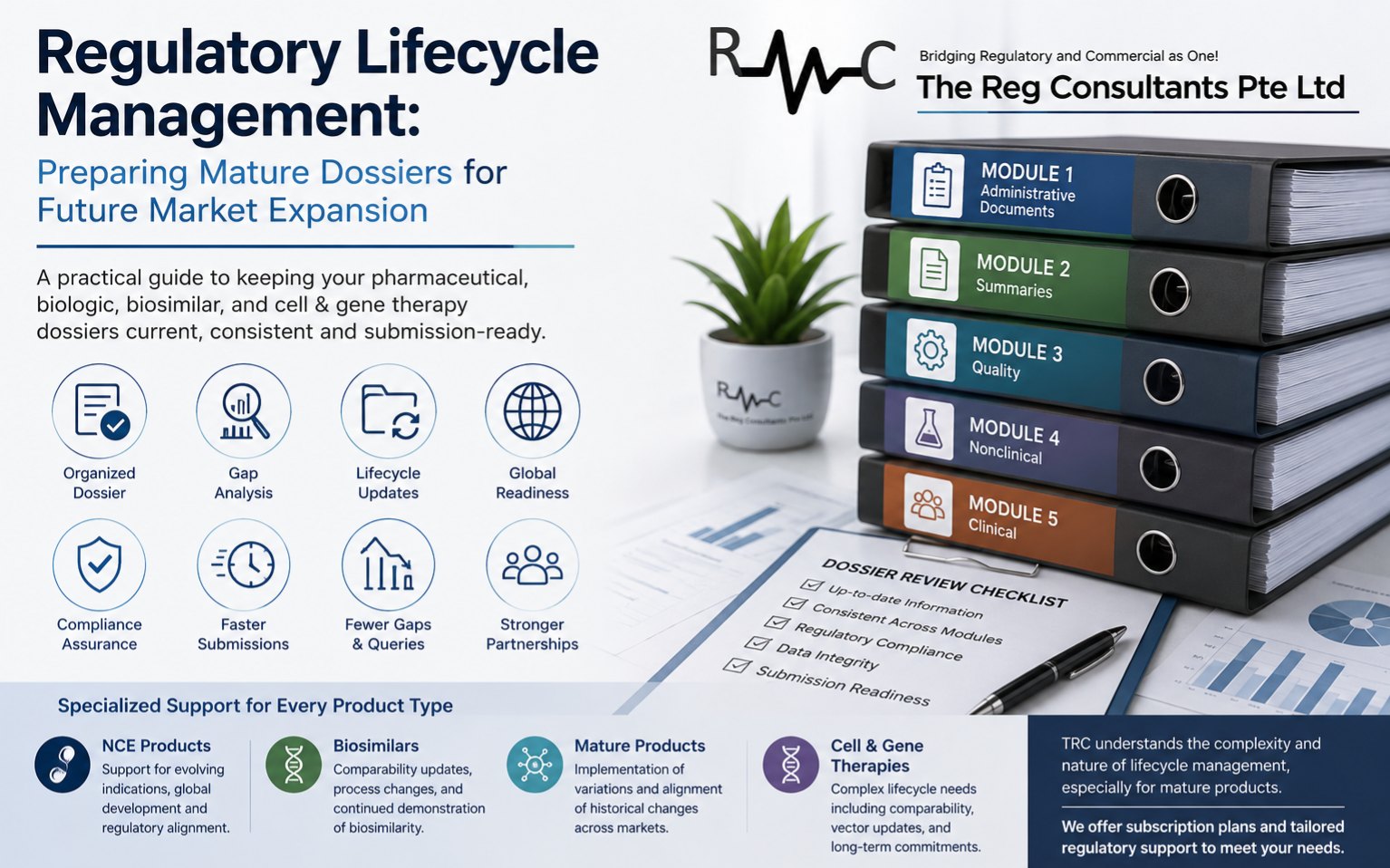
There is no better feeling than having an organised and updated product dossier within a regulatory inventory.
Regulatory professionals will resonate with this immediately.
In reality, many companies eventually encounter what we often refer to as “recycled dossiers” — dossiers which have undergone years of lifecycle changes, manufacturing updates, process improvements, supplier transitions, and post-approval variations across multiple markets. Over time, information becomes fragmented, historical sections remain outdated, and internal documentation no longer fully reflects current operational practice.
Before any new submission or market expansion can proceed, significant gap assessments may be required to reconcile the dossier with the current state of the product.
This ultimately delays timelines, increases deficiency queries, and creates additional regulatory workload.
For central dossier management teams, this situation is understandable. Regulatory lifecycle management is complex. Teams are simultaneously managing:
With competing priorities, dossier maintenance can gradually become reactive rather than proactive.
At TRC, we often support companies by performing targeted lifecycle dossier reviews to identify critical areas requiring alignment before regulatory submission, partner due diligence review, or market expansion activities.
Administrative documentation should remain current and submission-ready.
Common areas requiring verification include:
In many mature dossiers, outdated administrative documents remain embedded within historical submission packages, creating unnecessary clarification rounds during review.
Module 2 often provides the fastest indication of the overall quality and maintenance status of a dossier.
Quality Overall Summaries, Nonclinical Overviews, and Clinical Overviews should remain aligned with the latest information presented in Modules 3, 4, and 5.
Common issues observed include:
A well-maintained Module 2 significantly improves dossier readability and reduces downstream regulatory queries.
For mature pharmaceutical products, Module 3 maintenance becomes one of the most operationally intensive areas of lifecycle management.
Critical review areas may include:
In many legacy dossiers, pharmaceutical development sections are historically written and no longer adequately reflect internal process evolution implemented over time.
For mature generic portfolios, lifecycle management frequently involves ensuring that all implemented variations are consistently reflected throughout the dossier.
Over time, multiple post-approval changes may have been introduced involving:
Without periodic dossier restructuring, inconsistencies may emerge between approved changes and the current dossier state maintained internally.
For NCE products, lifecycle maintenance often extends beyond routine variation implementation.
Regulatory teams may need to evaluate:
As global development programmes mature, maintaining consistency across regional dossiers becomes increasingly important for efficient lifecycle expansion.
Biosimilar lifecycle management introduces additional complexity due to the continued importance of comparability throughout the product lifecycle.
Common lifecycle review considerations may include:
Even relatively small manufacturing changes may require careful assessment to ensure continued demonstration of biosimilarity.
For advanced therapy medicinal products (ATMPs), cell therapies, and gene therapy products, lifecycle management may involve highly dynamic operational and regulatory environments.
Areas commonly requiring ongoing review include:
Given the complexity of these products, maintaining an organised and continuously updated dossier structure becomes critical for sustainable lifecycle management.
While Module 4 may remain relatively stable for many mature products, updates may still be required where:
Lifecycle maintenance within Module 5 may involve:
As products mature commercially, pharmacovigilance activities often become increasingly important in supporting continued regulatory confidence.
For products maintained in eCTD format, periodic technical housekeeping is equally important.
This may include:
Technical inconsistencies within eCTD submissions can create avoidable review complications during regulatory assessment.
Dossier maintenance may be operationally demanding, particularly for mature portfolios managed across multiple markets. However, proactive lifecycle housekeeping significantly reduces regulatory gaps, improves submission readiness, and facilitates smoother partner due diligence and market expansion activities.
At TRC, we understand that lifecycle management is not a one-time exercise. As products continue to evolve commercially and technically, regulatory dossiers must continuously adapt alongside manufacturing updates, post-approval variations, safety commitments, analytical improvements, and changing regulatory expectations across different regions.
This becomes especially relevant for companies managing mature pharmaceutical products, biosimilars, advanced therapy products, or multi-market portfolios where internal regulatory resources are often balancing multiple competing priorities simultaneously.
Our regulatory lifecycle management support services are designed to assist companies in:
For companies requiring longer-term operational support, TRC also offers flexible regulatory subscription support models tailored to ongoing dossier maintenance, lifecycle management activities, variation support, and regional regulatory coordination needs.
Good dossier practice may often go unnoticed internally — until the next submission, partner review, or market expansion opportunity arrives. Maintaining an organised and continuously aligned dossier today can significantly reduce regulatory burden tomorrow.

If you have any specific regulatory questions pertaining to entering the Singapore market or require assistance with pharma regulatory services and medical product registration, feel free to reach out. Your success in the pharmaceutical industry starts with us!