 enquiries@theregconsultants.com


 0
0
Welcome to The Reg Consultants Pte Ltd (TRC)
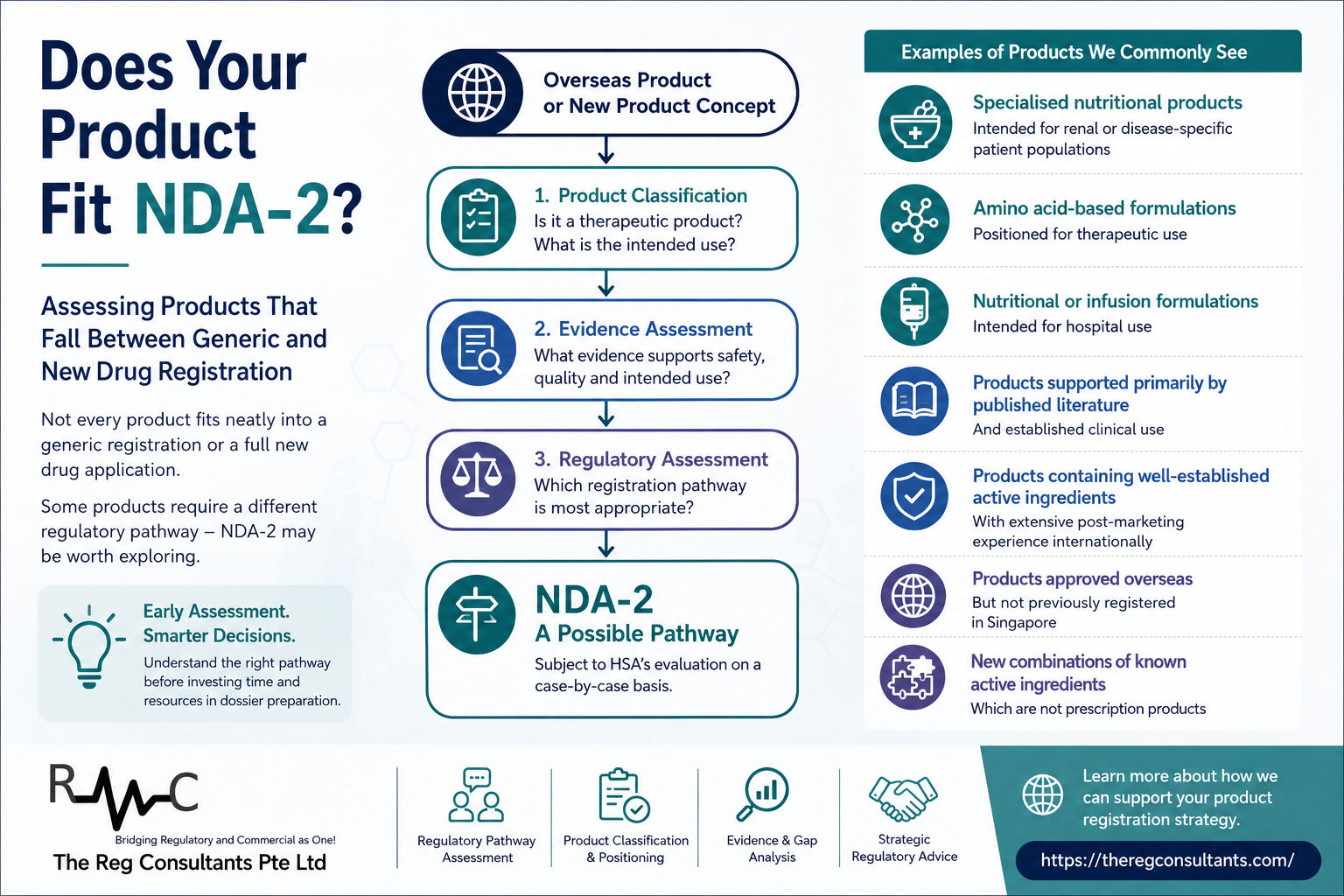
One of the more interesting enquiries we occasionally receive involves products that do not fit neatly into a conventional registration pathway.
They are not entirely new chemical entities or biological products.
They are not straightforward generic medicines.
Yet they may not be suitable for a simple literature-based justification alone.
These products often sit somewhere in between and require careful assessment before an appropriate regulatory strategy can be established.
Over the years, we have encountered enquiries involving:
In many of these situations, there are often misconceptions regarding the regulatory pathway.
“The product is already approved overseas, therefore the same regulatory approach should apply in Singapore.”
Not necessarily.
While overseas approvals can provide valuable supporting information, Singapore regulatory requirements remain independent and local expectations must still be addressed.
“The product classification in the country of origin will be the same in Singapore.”
Product classification can differ significantly between jurisdictions. A product classified as a non-prescription medicine, health supplement, medical food, or even a medical device elsewhere may be classified differently in Singapore.
This is one of the reasons why an early classification assessment is often important before substantial resources are invested in dossier preparation.
“A new clinical trial is always required.”
Not always.
Depending on the product, indication, and available evidence package, published literature, established clinical use, overseas regulatory experience, and existing clinical data may contribute to the overall justification strategy.
However, the adequacy of the evidence package must be assessed on a case-by-case basis.
“Existing literature can automatically support any new indication.”
The existence of published literature alone may not be sufficient.
The quality, relevance, applicability, and consistency of the available evidence remain important considerations when determining whether the proposed indication can be adequately supported.
Even where a product may potentially be considered under an NDA-2 pathway, companies should not assume that regulatory expectations are significantly reduced.
The submission may still require a comprehensive dossier package including:
The key difference is often not the absence of evidence requirements, but rather how the evidence package is constructed and justified.
For products with well-established active ingredients and recognised clinical use, scientific discussion supported by published literature and existing evidence may reduce the need for generating entirely new clinical studies. However, each product must be assessed individually.
In our experience, one of the most valuable activities at the beginning of a project is determining whether the product is appropriately classified and whether the available evidence package is sufficient to support the intended regulatory strategy.
This may involve:
An early assessment often helps companies avoid unnecessary regulatory delays and better understand the data requirements before committing significant development resources.
At TRC, we assist companies in assessing product classification, evaluating regulatory pathways, reviewing evidence packages, and identifying potential dossier gaps before submission planning begins.
For products that do not fit neatly into conventional registration categories, an early regulatory assessment can often provide greater clarity on whether an NDA-2 strategy may be appropriate and what supporting documentation may be required to support a successful submission.

If you have any specific regulatory questions pertaining to entering the Singapore market or require assistance with pharma regulatory services and medical product registration, feel free to reach out. Your success in the pharmaceutical industry starts with us!